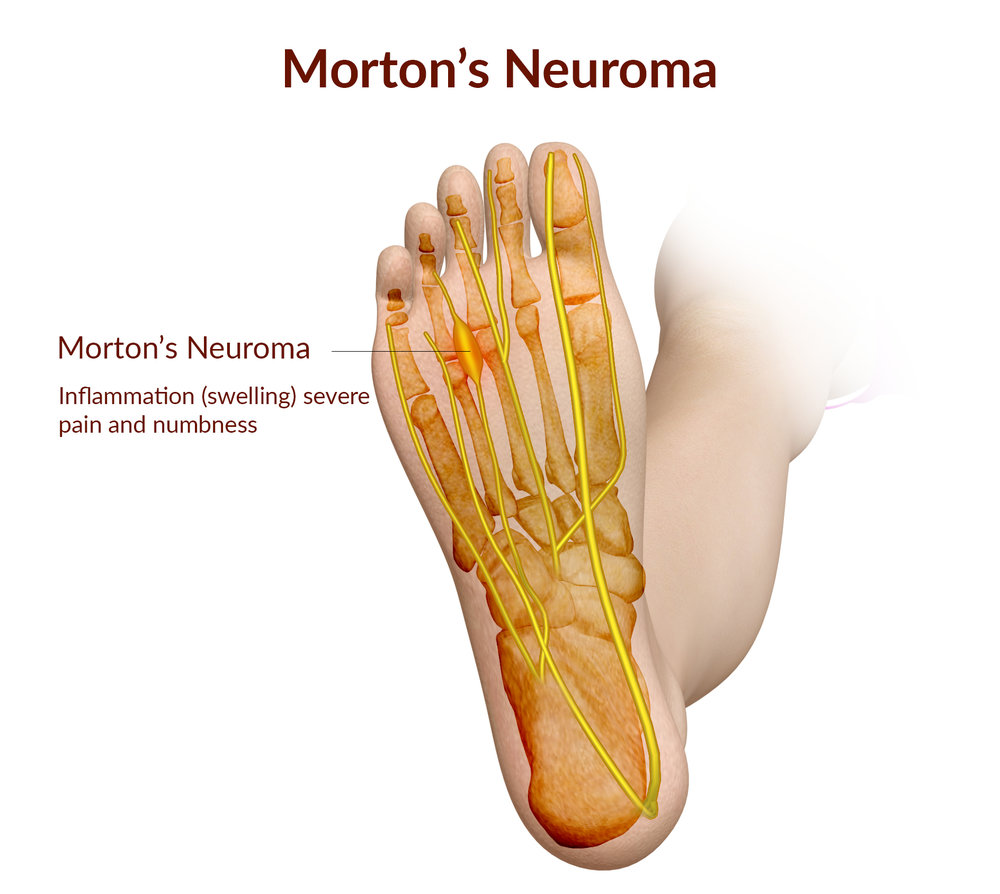
Neurectomy (Nerve excision).
The operation can be performed comfortably under a local anaesthetic block, which is achieved by a series of injections around the ankle. You can remain fully awake during the operation and will be able to feel touch, pressure and vibration, but you will not feel any pain.
The operation takes about 15–20 minutes although you will be in the day surgery unit for some time before the surgery and afterwards, to allow you an opportunity to rest post-operatively. You must have a competent adult at home for the first day and night after surgery. This allows us to be sure you will be safe for the first night.
Aims of Surgery
- Relieve pain and disability in the forefoot.
- Improve the patient’s quality of life.
Advantages of this Operation
Relieves pain and improves quality of life in approximately 80–90% of patients.
Specific Risks of this Operation
- Stump neuroma.
- Recurrent bursae.
- Scarring.
- Pain at the surgical site.
- Potential need for further surgery.
- Deep vein thrombosis or pulmonary embolism.
Operation Time
Usually between 15–20 minutes.
Incision Placement/Stitches
Incision is made on the top of the foot over the area where the neuroma is located.
Procedure
- The incision is deepened to identify the thickened nerve and likely bursae.
- The nerve is cut near the toes and traced back under the ball of the foot, then removed.
Fixation
None.
Is This a Day Procedure?
Yes, you will go home the same day.
Estimated Time Off Work
- Non-manual work: approximately 4–6 weeks.
- Manual work: approximately 6–8 weeks.
Indications for the Procedure
- Pain from beneath the ball of the foot not relieved by conservative care.
- Difficulty with shoe fit despite wearing sensible footwear.
Alternative Treatments
Manage symptoms by altering activity levels, using painkillers and anti-inflammatories, extra depth/width shoes, rocker sole (stiff curved sole), insole or orthotic foot support, and joint injection therapy.
Post-Operative Care
First 2–4 days after surgery
-
This is the time you are likely to have the most pain, but you will be given painkillers to help. You must rest completely for 2–4 days.
-
You will be able to stand and take weight carefully after the operation with your post-operative shoe on at all times, but you must rest, with your feet up, as much as possible.
-
You should restrict your walking to going to the bathroom.
-
You can get about a little more after 2 days.
1–2 weeks after surgery
-
You may need to attend for your foot to be checked and redressed.
-
You may start to do a little more within pain limits. Pain and swelling means you are doing too much.
Between 2–4 weeks after surgery
-
The foot starts to return to normal and you can return to normal shoes (4–8 weeks) (89%).
-
The foot will still be quite swollen especially at the end of the day.
-
You may return to work but may need longer if you have an active job.
-
You may return to driving if you can perform an emergency stop. You must check with your insurance company and Mr. Cichero before driving again.
-
Whilst normal activity will be resumed, sport should be avoided.
Between 8–12 weeks after surgery
-
The foot should continue to improve and begin to feel normal again.
-
There will be less swelling.
-
Sport can be considered after 2–3 months depending on your recovery.
12 months after surgery
-
The foot has stopped improving with all healing complete.
Please note, if a complication arises, recovery may be delayed.
Start your healthcare journey
For more information, questions or queries, please email us or call 01872 392087.